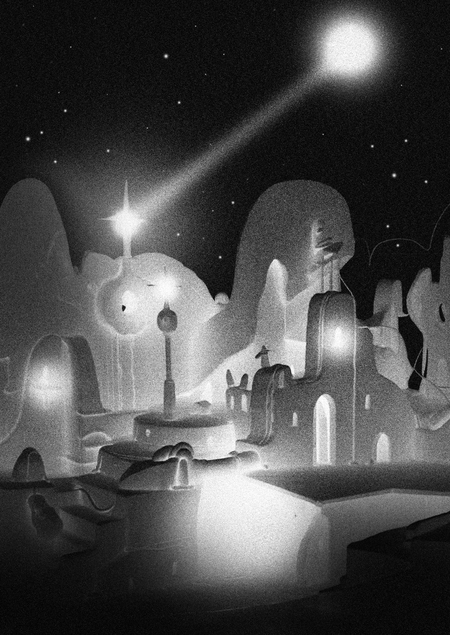
Geismar: injured luminous planet

The Planet of Geismar
This is Guismar, a tiny, burned planet. She was once hit by a meteorite called «star,» which partially exposed the core of the planet. This planet can be identified by the bulge that emits the most beautiful light. The fall of the «star» hurt the atmosphere of the planet, causing the sun’s rising to burn all living things and even contribute to mutation.
Geismar is located in the Andromeda galaxy. It’s so remote in space that any notion of time that we’re familiar with stops working there.

The approximate location of the planet Geismar is the west of the Andromeda galaxy
Time runs differently in Geismar: the day can feel like a year and the year can feel like a moment. The past, the present and the future are not as clear as ours, and it is not possible to say exactly when the events on the planet took place. For us, this is not measured by the usual dates and calendars. We can only say one thing: Geismar does not exist «in a particular year», but rather as a place outside our time, a separate reality with its own rhythm of life and death.
First disaster
Moment of meteorite collapse
Once upon a time, there was a powerful meteor shower on the planet. One of the meteorites, the largest one to be called a fallen star, has caused enormous damage to the planet, so much that the core of the planet has come out in part. That’s how the death crater came into being. If you get as close as you can to the epicenter of the disaster, you can see the core, but you better not: the instant death will be assured. The «Sun River» (or «Saulesupes», as one people called it) began to come from the core of the planet. It’s a radioactive radiation that slowly fills the landscape of the planet. For intelligent civilization, it is deadly. Since the disaster, life has been divided into those who try to survive and rebuild the planet and those who choose to worship destruction.
Geismar: Light from the star’s place of fall
What was in Guismar before the crash?
Geismar before the disaster
Once upon a time, Geismar was different. There were no developed civilizations, technologies or cities. The planet was covered by huge, dense fields of strange alien plants. They weren’t reasonable — they were just tough, survival flores adapted to heat and dryness. These plants lived by simple natural laws, reaching for light, absorbing energy, fighting for existence, and filling most of the planet’s surface. The plants didn’t die after the star’s fall. On the contrary, they started mutating.
How did the plants become reasonable?
The process wasn’t fast, it took a lot of time. As a result of radiation and special light, plant kernels began to become more complex: they developed new structures, became more flexible, and began to exchange energy and signals. Over time, some of them have become the middle between a living organism and a machine. It is from these modified organisms that Prats' civilization later emerged — creatures that are both human, plant, and machine-like. Some plant life has learned to filter, close, and distribute the flow within itself. This is how the first civilizations, the forms that seek to maintain the balance, emerged. Others have accepted the radiation completely and have become creatures that are open to the light and depend directly on it.
The planet was divided not only physically, but also ideologically.
On the one hand, the Pratsa (Zum). They believe that peace can be maintained, restored, at least stabilized. They act wisely: build, protect, seek solutions. On the other hand, Sirds (heart). They took radiation as a god. They consider the sun’s river sacred, and everything destructive is right.
So a disaster that could destroy the planet eventually created a reasonable life — but a life that is constantly struggling to survive in a world that has become too dangerous.
Prats —. . . . . . . . . . . . . . . . . . . . . . . . . . . . . . . . . . . . . . . . . . . . . . .

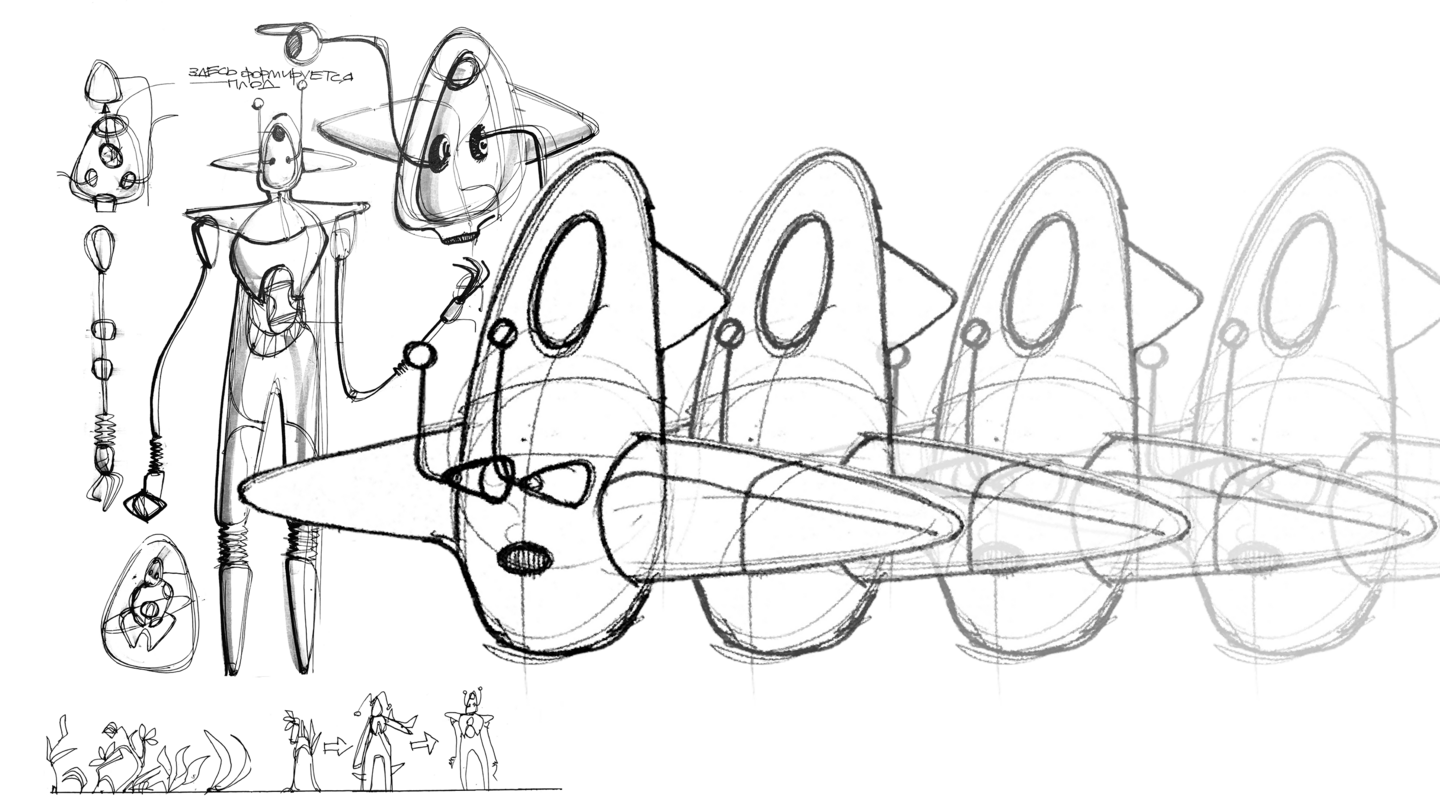
Artic concept: the appearance of the Pratts
Prats are a rational and rational civilization with its own small and hidden state. Semi-transparent two-legged creatures. They study the core, build clay houses or dig caves, collect the necessary material to live in a deadly zone. They found reason and ceased to be «biological» beings in the conventional sense. Their lives are a mixture of life and technology.
The Prats are the only ones who can continue the life of civilization, though very difficult.
Prats aren’t born naturally. They’re grown in energy cocoons. Every new birth requires a huge amount of energy. Therefore, new «children» are very rare.
Battery hearts
Pratosirds (battery heart): concept art
There’s an energy core, a battery heart, or a Pratosirds, in the chest of every pritz. It stores light, energy, and heat. The Prats don’t eat. They need the energy of the fallen star that they derive from the crater. When this energy is scarce, they die slowly.
In order to sustain life, the prats, risking their lives, are forced to regularly go to the place where the star falls for the necessary «materials of life».
Work of the Pratts in the Crater’s Inners
The Prats have invented a way to extract energy from the crater. This technology is called Nemgaismus.