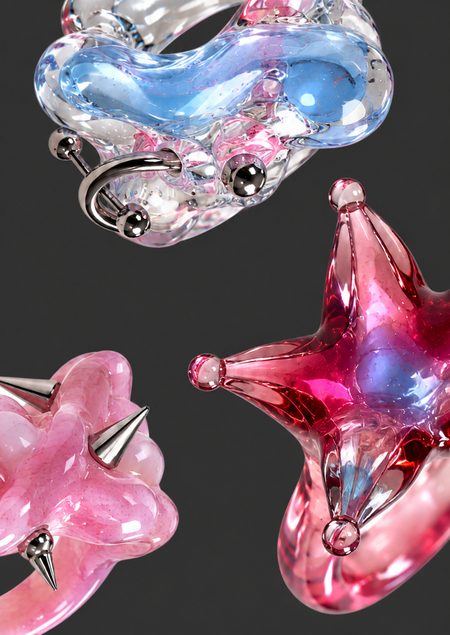
SEVENTEEN × LA VALEUR — a collaboration between a fictional French bank and an experimental jewelry brand. Together, they transform contactless payment into a stylish piece of colored glass jewelry in the form of a series of payment rings.
/01 CONCEPT
What if a bank card became an accessory?
LA VALEUR — a fictional French bank embodying the aesthetic of quiet luxury, elegance, and impeccable service. SEVENTEEN — a jewelry brand for those who find the conventional restrictive: bold, youthful, and drawn to unconventional forms. Together, they have created a collection of glass rings integrated with contactless payment technology. Transparent, colored glass, whimsical silhouettes, and hidden electronics transform a routine transaction into a small gesture that one wants to repeat. Simply tap the ring against the terminal—your card and phone can remain tucked away in your pocket.Who is this for? For the generation aged 20–35, who chooses pieces with character. They pay attention to design, appreciate experimental jewelry, and value technology when it integrates seamlessly into life. They want to use convenient things without sacrificing their own style.
/02 ANALOGS
Existing payment rings, such as TAPSTER and CNICK, utilize NFC technology for contactless payment without needing a battery or charging.
LA VALEUR × SEVENTEEN develops this concept through jewelry design: a sculptural ring made of colored, transparent glass featuring a hidden payment module.
The project’s distinction lies in its removable capsule, which contains the NFC chip and antenna, allowing it to be extracted for maintenance or replacement while preserving the glass housing of the piece of jewelry.
/03 TECHNOLOGY
Manufacturing Process
Primary Method—glass is cast into a mold and then annealed. Model Creation. A master model is fabricated for the ring, incorporating the decorative star and the cavity for the electronic module. Glass Forming. Colored glass is sintered or cast in a heat-resistant mold that defines the silhouette and internal cavity. Annealing and Finishing. The glass is slowly cooled to relieve internal stress, then ground and polished. Assembly. A removable capsule containing the NFC module is installed into the finished body and secured with a separate mechanical fixture.Technical Constraint: because the glass is brittle, the geometry of the cavity and the wall thickness must be verified during prototyping. The opening for the module is better formed during the casting process rather than drilling it into the finished ring./04 MATERIALS
/05 BUDGET
/06 PRODUCTION
Production and Assembly
Housing Molding — creation of the glass ring featuring a decorative star and an internal cavity.
Glass Finishing — sanding and polishing of the surface.
Module Assembly — installation of NFC electronics into the protective capsule.
Final Assembly — mounting the capsule into the housing and securing the removable lid.
Result: a finished glass ornament with integrated contactless payment technology.
/07 DRAWING
Key Dimensions of the Ring:
Overall star diameter — 24 mm
Vertex diameter — 18 mm
Height of the decorative element — 8 mm
Inner ring diameter — 17 mm
Bezel thickness — 4 mm
Total ring height — 24 mm
Side structure thickness — 8 mm
Glass wall thickness — 2.5 mm
Inner cavity height — 5 mm
— All dimensions are specified in millimeters. These must be verified against the actual ring geometry and payment module dimensions before production.
/08 PACKAGING
Packaging and Shipping
Packaging. A rigid case with a soft inner lining protects the glass ring from bumps and scratches. The electronic module is secured inside the casing to prevent shifting during transit.
Shipping. The finished items are placed in individual cases, and then into transport boxes with protective filler.
Delivery to Customer. The ring is delivered in branded packaging with instructions for using and connecting the payment module.